
— EMDR THERAPY - BRITISH COLUMBIA

Your past doesn’t have to run the present.
30+
Randomized controlled trials supporting EMDR
for PTSD
You've tried to move on. You've talked about it, understood it, made sense of it. But something in you hasn't caught up yet. EMDR works at the level where words don't reach — helping your brain finally finish processing what got stuck.
-
The World Health Organization lists EMDR as a first-line treatment for PTSD alongside trauma-focused CBT — a distinction earned through decades of independent research.
-
Available virtually across BC, and in-person in Delta (Ladner) and East Vancouver. Sessions offered Monday through Saturday.
-
Jonathan completed EMDRIA-approved Basic Training in EMDR. This ensures your care meets the internationally recognized standard for safe, ethical practice.
UNDERSTANDING THE APPROACH
What is EMDR — and why does it work?
EMDR stands for Eye Movement Desensitization and Reprocessing.
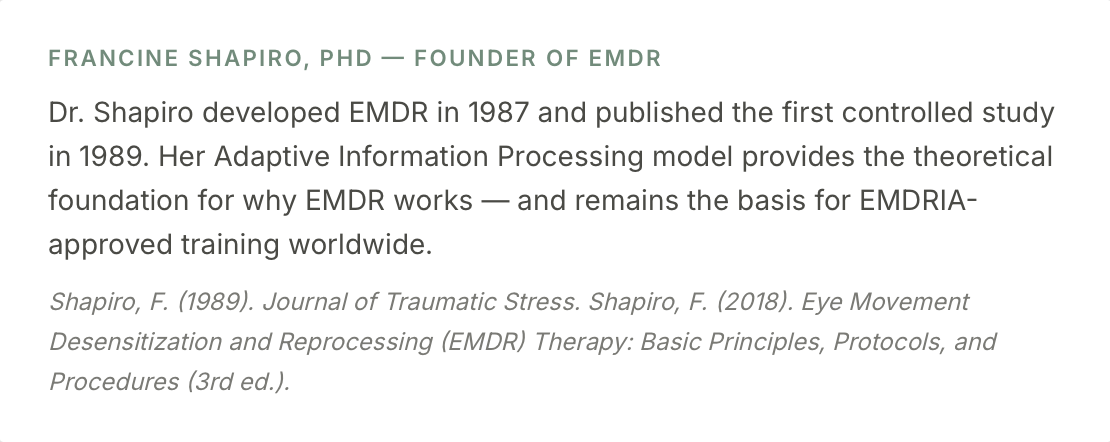
In 1987, psychologist Dr. Francine Shapiro noticed something unexpected: moving her eyes back and forth while thinking about a distressing memory caused that memory to feel less intense. This discovery led to decades of research and one of the most effective trauma therapies available today.
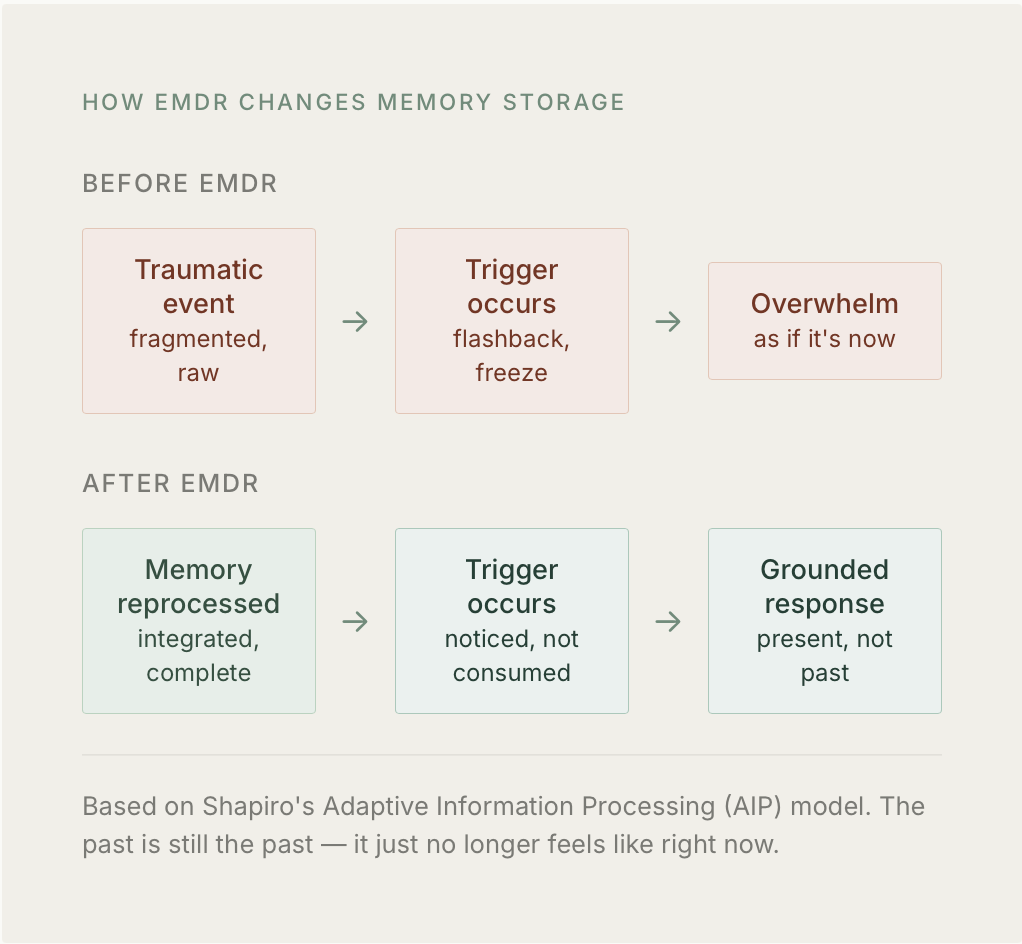
The theory behind EMDR is called Adaptive Information Processing (AIP). When something traumatic happens, the brain sometimes can't fully process the experience — especially if it happened too fast, was too frightening, or occurred when you were very young. The memory gets stored in a raw, fragmented form. Sounds, images, sensations, and beliefs get locked in together, and anything that resembles the original event can trigger a flood of those stored reactions.
EMDR uses bilateral stimulation — gentle, rhythmic left-right movement through eye movements, taps, or tones — while you hold a distressing memory in mind. This activates the brain's natural processing system, the same mechanism that works during REM sleep, allowing stuck memories to be integrated and transformed.
You don't have to narrate the story in detail. You don't have to relive it. You simply notice what comes up while the processing happens — and over time, the charge on those memories diminishes. What was once overwhelming becomes something you can hold without being taken over by it.
THE EMDR PROTOCOL
Eight phases. One through-line: safety.
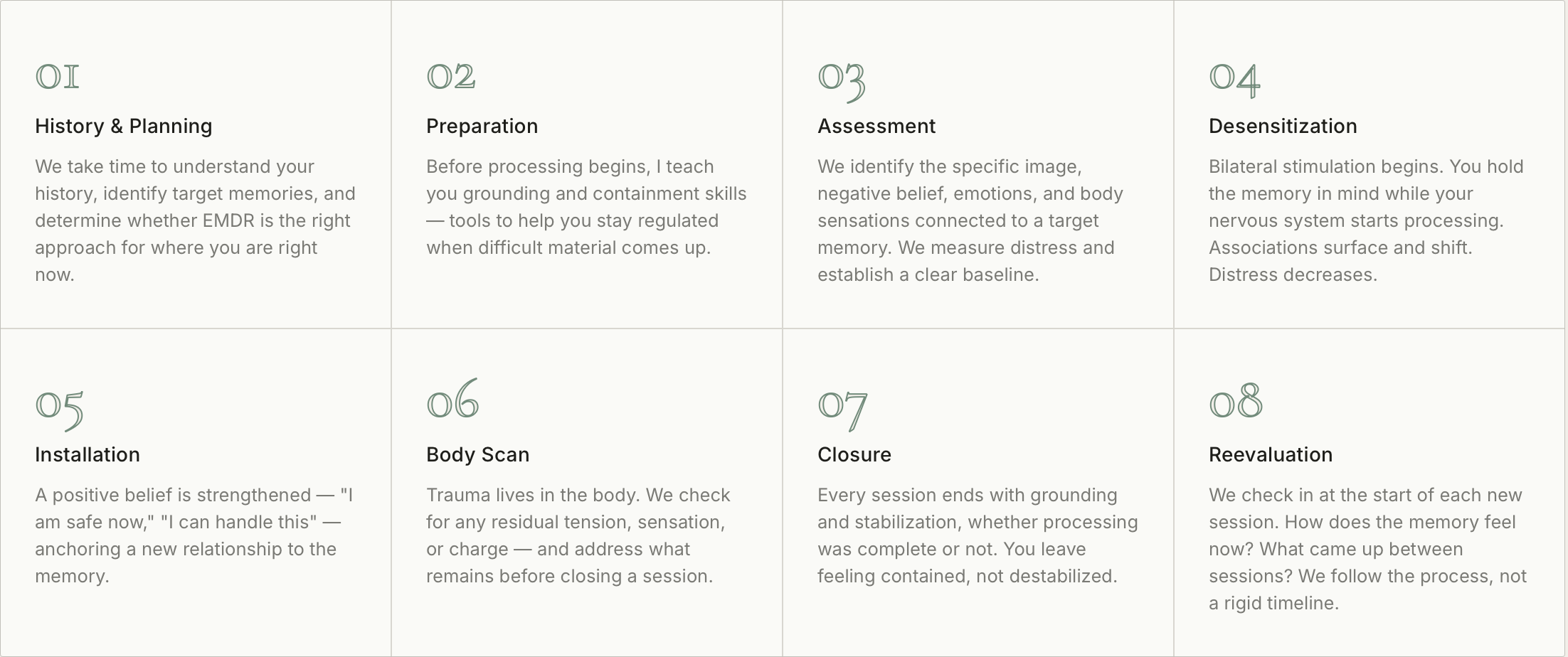
EMDR isn't just bilateral stimulation. It's a structured, eight-phase protocol developed by Shapiro and refined by decades of research. Nothing in the process is improvised. You will always know where you are, what's happening, and why.
WHAT EMDR CAN ADDRESS
It started with trauma. The reach goes further.
EMDR was originally developed for PTSD. But the same mechanism that processes traumatic memories can help with a surprisingly wide range of experiences.
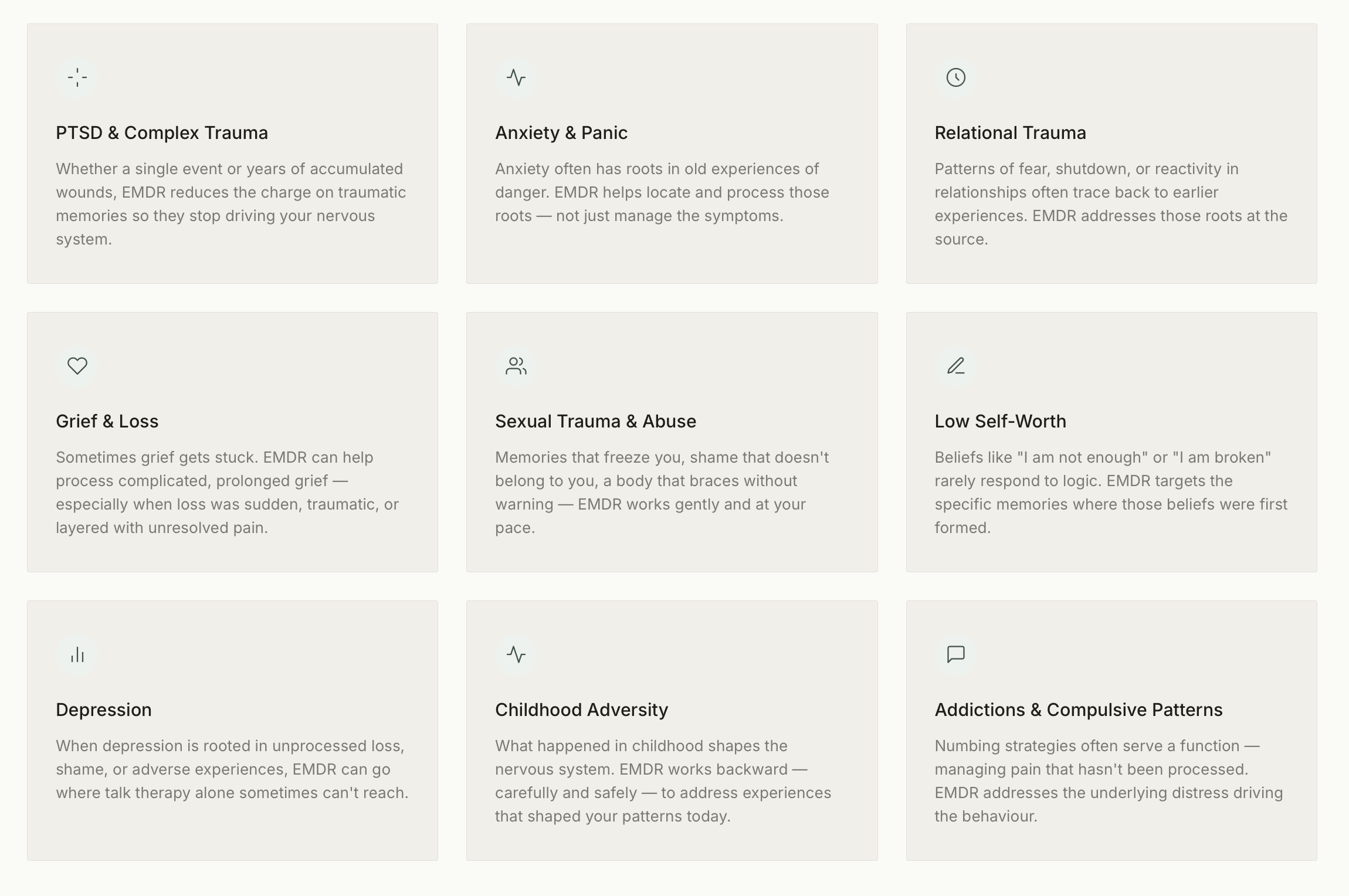
This isn't fringe. It's one of the most studied therapies in existence.
EVIDENCE BASE

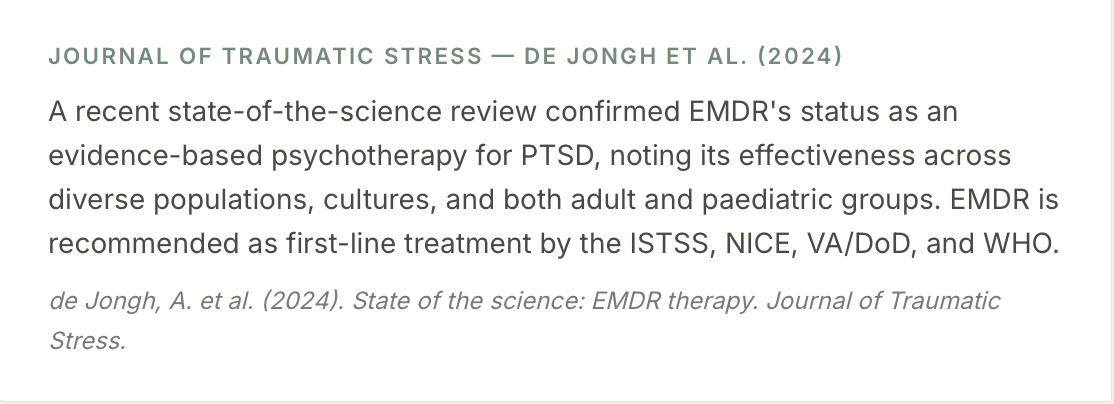
The research on EMDR has accumulated over 35 years, across cultures, populations, and trauma types. The findings are consistent.
GETTING STARTED
What it actually looks like to begin.
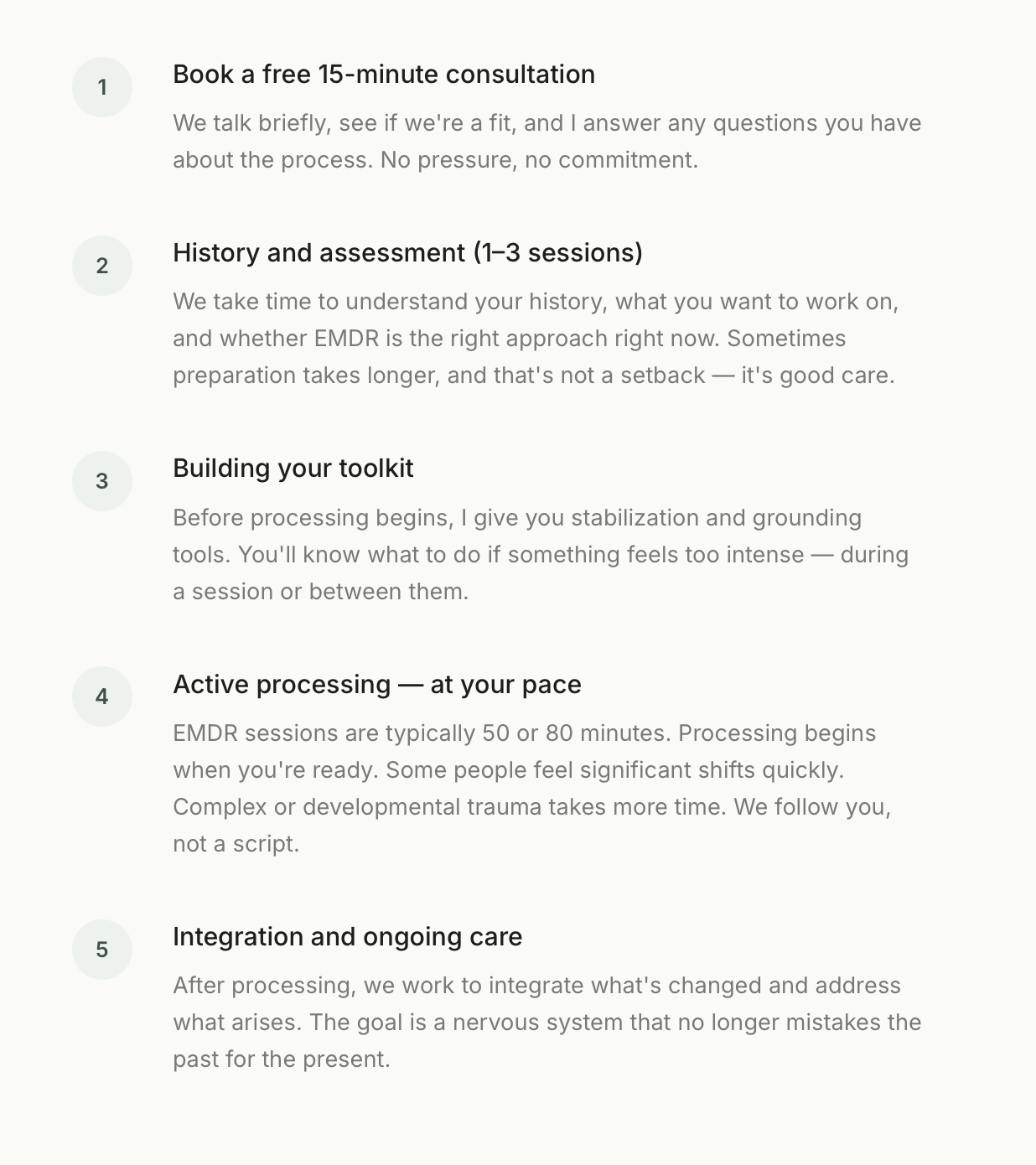
EMDR isn't something that starts the moment you walk in. Safety comes first. Always.


Frequently Asked Questions
Still have questions? Take a look at the FAQ or reach out anytime. If you’re feeling ready, go ahead and give me an email or book a session.
-
No. EMDR can be done with eyes open, using tapping or auditory tones instead of eye movements. We'll find the form of bilateral stimulation that feels right for you.
-
Not necessarily. Unlike some trauma approaches, EMDR doesn't require you to narrate your story in detail. You'll simply hold a memory in mind while processing happens. Many people find this a relief.
-
Yes. EMDR can be effectively delivered virtually through a secure video platform. I offer virtual sessions to anyone in British Columbia. Research supports the effectiveness of online EMDR for trauma processing.
-
It varies. Single-incident trauma may shift meaningfully in 3–8 sessions. Complex or developmental trauma takes longer. We'll regularly check in on where you are and adjust the pace accordingly. There's no standard timeline — only your timeline.
-
Yes — and this is often how Jonathan works. IFS (Internal Family Systems) is particularly complementary to EMDR because it helps identify the parts of you that hold traumatic material before processing begins. DBT skills build the emotional regulation needed to engage safely with difficult memories.
-
Some people notice an increase in dreams, emotions, or memories between sessions — this is a normal sign that processing is continuing. You'll always leave a session with grounding tools in hand.
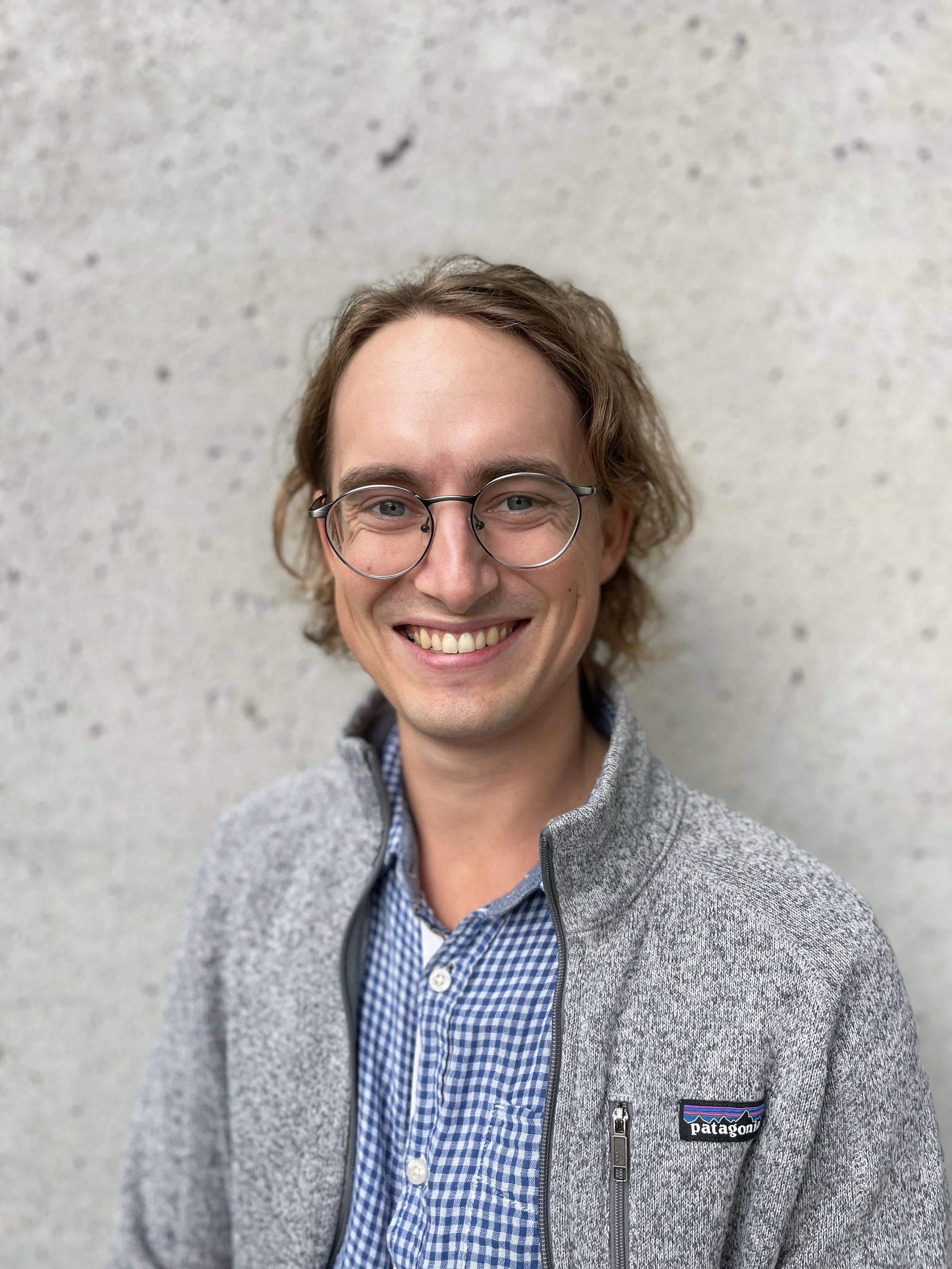
I became a therapist because I know what it is to be given time and honest attention by someone who wasn't there to fix me — just to stay with me while I found my footing.
I work with people carrying things that haven't responded to understanding alone. Trauma, anxiety, relational patterns that repeat no matter how clearly you see them. EMDR is the approach I reach for when talking about something hasn't been enough to shift it.
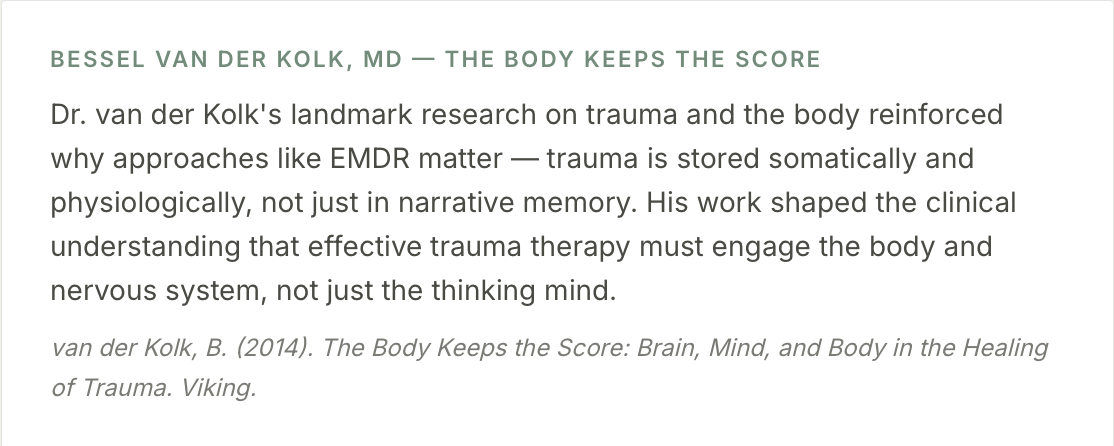
I completed EMDRIA-approved Basic Training with Jasmine Alexander, and I integrate EMDR with IFS (Internal Family Systems) and DBT to offer care that meets the full complexity of what my clients bring. My work is shaped by the research of Francine Shapiro, Bessel van der Kolk, Gabor Maté, and Peter Levine — clinicians who understood that trauma lives in the body, not just the story.
I offer a structured, grounded, and genuinely compassionate presence. I won't rush you. I won't pathologize you. And I'll always tell you where we are in the process.
Registered Clinical Counsellor (RCC #22056) · BCACC
Master of Counselling Psychology · Yorkville University
EMDRIA-Approved Basic Training in EMDR · Jasmine Alexander
EMDR Therapy with Complex Trauma and Dissociative Personality Structure – Jim Knipe, PhD
Dick Schwartz IFS Masterclass · Complex Trauma & PTSD
DBT Skills Training · Marsha Linehan (Behavioural Tech)
AEDP Viewed Through the Lens of EFT · Dr. Richard Harrison